
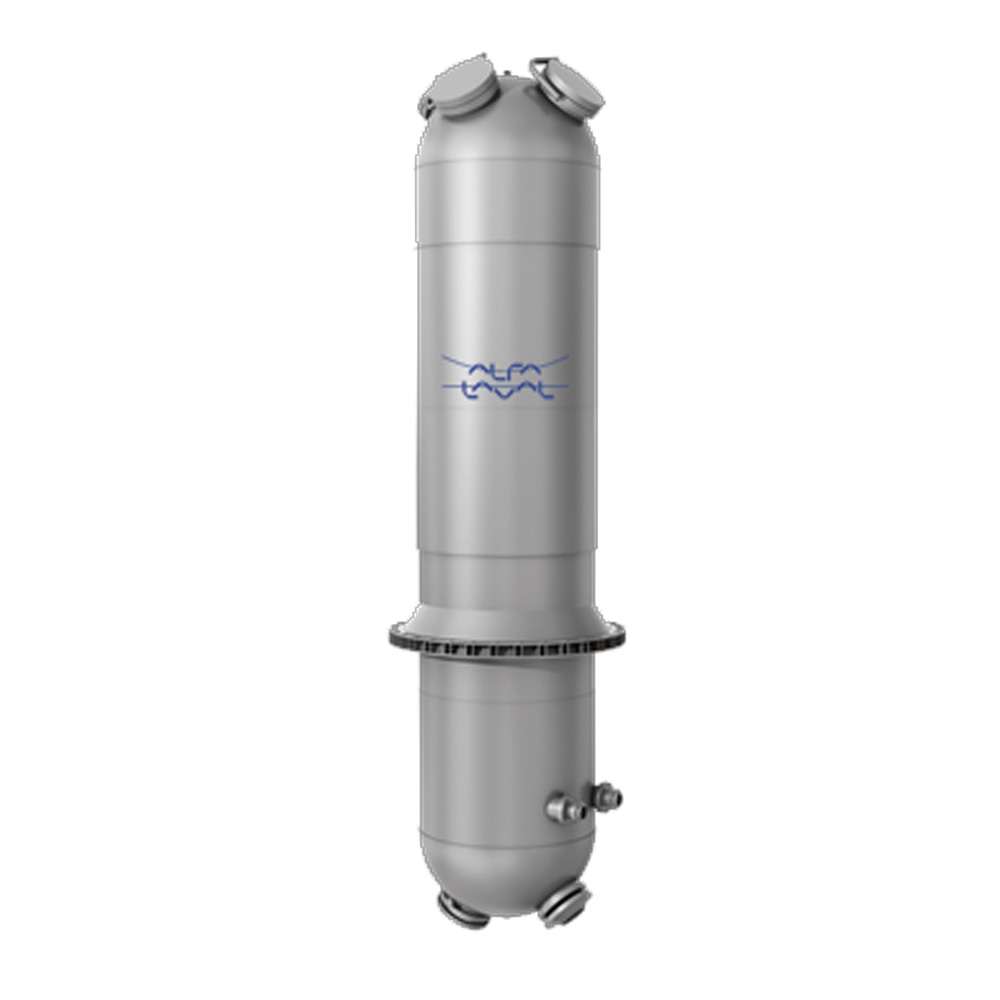
Packinox
| Application | |
|---|---|
| Brand | |
| Industry | , , |
| Access-products |
A Packinox heat exchanger is ideal for demanding heat recovery duties in processes with high pressures and temperatures. Its outstanding thermal performance, superior hydraulic efficiency and low CAPEX allow you to optimize energy efficiency, increase profitability and improve sustainability. A Packinox enables higher yield and recovers more heat than a shell-and-tube solution, resulting in better ROI and a lower environmental impact. Packinox is also available as plate-and-frame configuration.
Reliable efficiency
- Lower OPEX – The high heat recovery leads to substantial energy savings. Maintenance costs are also low thanks to minimal fouling.
- Lower CAPEX – A single Packinox can replace several large shell-and-tubes and makes it possible to operate processes with smaller furnaces and cooling
- Higher process yield thanks to a low pressure drop, optimal liquid/gas mixing, high operating flexibility and a fully customized design.
- Reliable, proven technology – More than 350 units in operation worldwide.
- Real-time monitoring and continuous optimization by Alfa Laval experts.
Unique features
Explosion Forming
High-strength plates with long, reliable lifetime
HyperCut
Unique plate design that increases reliability and reduces pressure drop
Spray Bar
Effective mixing of the liquid feed and the recycle gas (applicable for the plate-and-shell model only)
ALOnline
Digital services for maximum uptime and performance
ALOnsite
Qualified support at your facility
Plate Wash
Monitors the pressure drop in the heat exchanger and allows operators to engage water cleaning whenever ammonium salt fouling begins to accumulate.
Unique HyperCut plate design improves thermal efficiency
Alfa Laval’s unique HyperCut heat transfer plates have many benefits:
- 50% lower pressure drop over the distribution areas compared to the previous design. This makes it possible to either increase heat recovery, reduce the size of the heat exchanger or to lower the overall pressure in the process.
- 30% higher mechanical strength and higher resistance to thermo-mechanical stress.
- Improved flow and pressure distribution, which improves operability
How it works
The recycle gas enters the heat exchanger at the bottom and passes the Spray Bars on its way into the plate pack. The liquid feed enters from the side and is sprayed into the gas by the Spray Bars. This ensures a perfect mix of liquid feed and recycle gas, which facilitates lifting and makes it possible to operate the unit on a high liquid-to-gas ratio for maximum yield.
The feed/gas mixture moves up through the plate pack while the reactor effluent travels in the opposite direction. The highly turbulent, counter-current flow ensures that most of the heat from the reactor effluent is recovered and heats the cold feed. The hot approach temperature can be as low as 25°C (45°F).
The outstanding heat recovery reduces the load on both the reactor heater and the cooling system compared to using other types of heat exchangers, thereby reducing both OPEX and CAPEX.
How it works
The recycle gas enters the heat exchanger at the bottom and passes the Spray Bars on its way into the plate pack. The liquid feed enters from the side and is sprayed into the gas by the Spray Bars. This ensures a perfect mix of liquid feed and recycle gas, which facilitates lifting and makes it possible to operate the unit on a high liquid-to-gas ratio for maximum yield.
The feed/gas mixture moves up through the plate pack while the reactor effluent travels in the opposite direction. The highly turbulent, counter-current flow ensures that most of the heat from the reactor effluent is recovered and heats the cold feed. The hot approach temperature can be as low as 25°C (45°F).
The outstanding heat recovery reduces the load on both the reactor heater and the cooling system compared to using other types of heat exchangers, thereby reducing both OPEX and CAPEX.