


Nexus – Pilot Plant for Fat Crystallization – Small-Scale Scraped Surface Heat Exchangers
| Access-products | |
|---|---|
| Application | , , |
| Brand | |
| Industry | , |
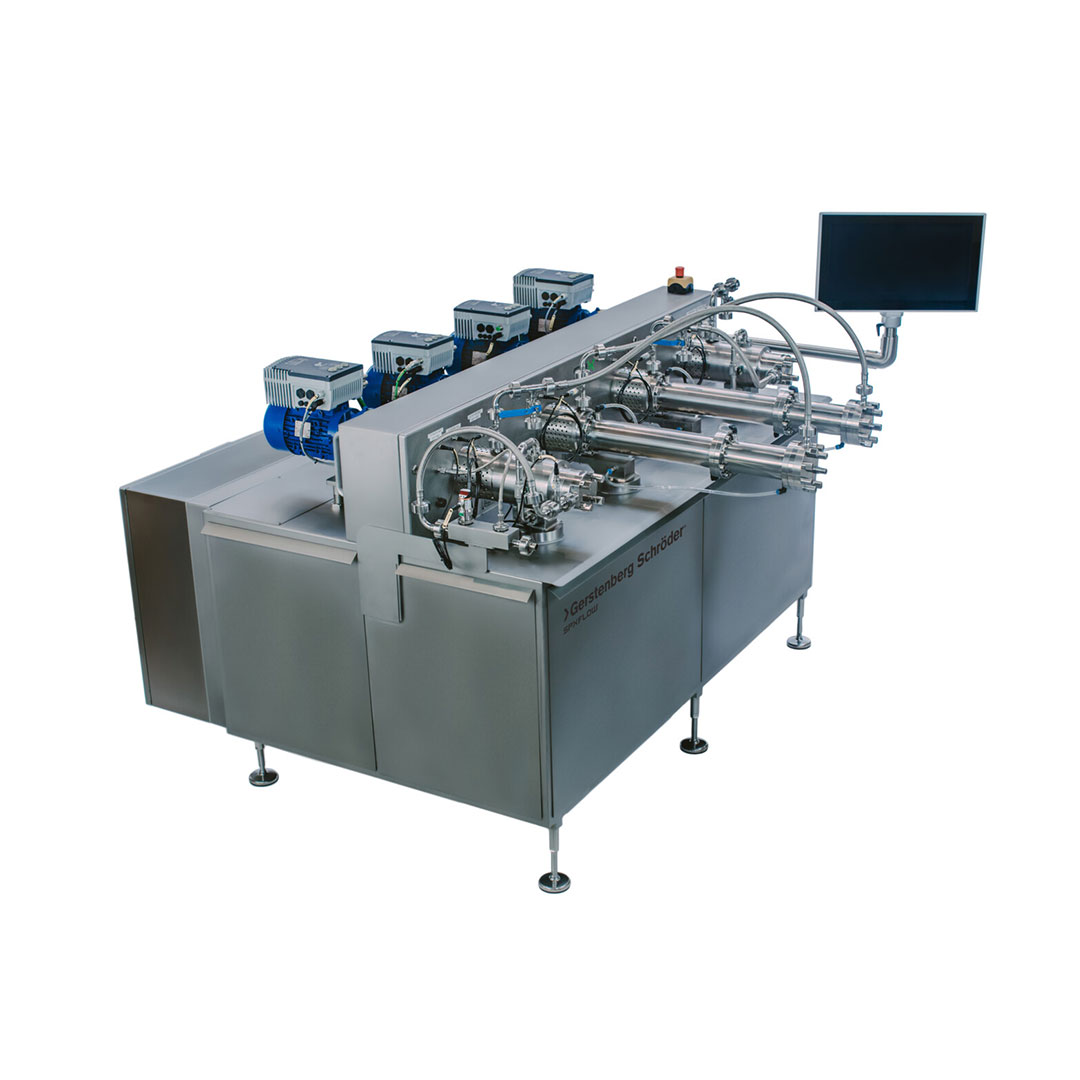
he Gerstenberg Schröder Nexus Pilot Plant is a highly flexible and modular system designed to test various high-viscosity applications in the dairy, fats and oils, and processed food industries. It provides the opportunity to process small-scale samples under the exact same conditions as those in large-scale production facilities. The Nexus Pilot Plant is designed for high efficiency and low energy consumption, utilizing environmentally friendly and highly efficient CO2 as a refrigerant.
Nexus Pilot Plant: Modular Innovation for Thermal Processing
Skid-Mounted Modular Architecture
The system comprises multiple fully piped, wired, and factory-tested modules designed for flexible configuration and rapid deployment.
Core Table Module Design
Includes up to four slots for SSHE and pin rotor machines, CO₂ refrigeration, built-in compressor, and SCADA touch interface.
Additional Module Availability
Options include add-on tables for pin rotor machines, inverters, resting tubes, batching systems, pumps, pasteurizers, rework skids, and emulsifiers for processed food applications.
Quick Connection and Reconfiguration
Flexible piping enables fast reassembly for different applications with minimal disruption.
Function and Operating Principles
Crystallization via SSHE
Product cooling and crystallization occur inside the scraped surface heat exchanger, where centrifugal scraper force ensures efficient product consistency.
Production Capacity
Throughput Range
Capable of processing between 40–160 kg/hour.
Advantages of the Nexus Pilot Plant
Versatile Processing Capability
- Supports heating, cooling, crystallizing, and emulsifying for dairy, fats & oils, and processed foods
Scalable and Efficient
- Small-scale batch testing under real production conditions
- Plug-and-play setup with SCADA integration
Ease of Maintenance and Cleaning
- Quick set-up changes via flexible piping
- Streamlined cleaning and reduced downtime
Energy and Environmental Advantages
- Efficient CO₂ refrigeration delivers superior heat transfer and reduced energy use compared to ammonia and Freon