
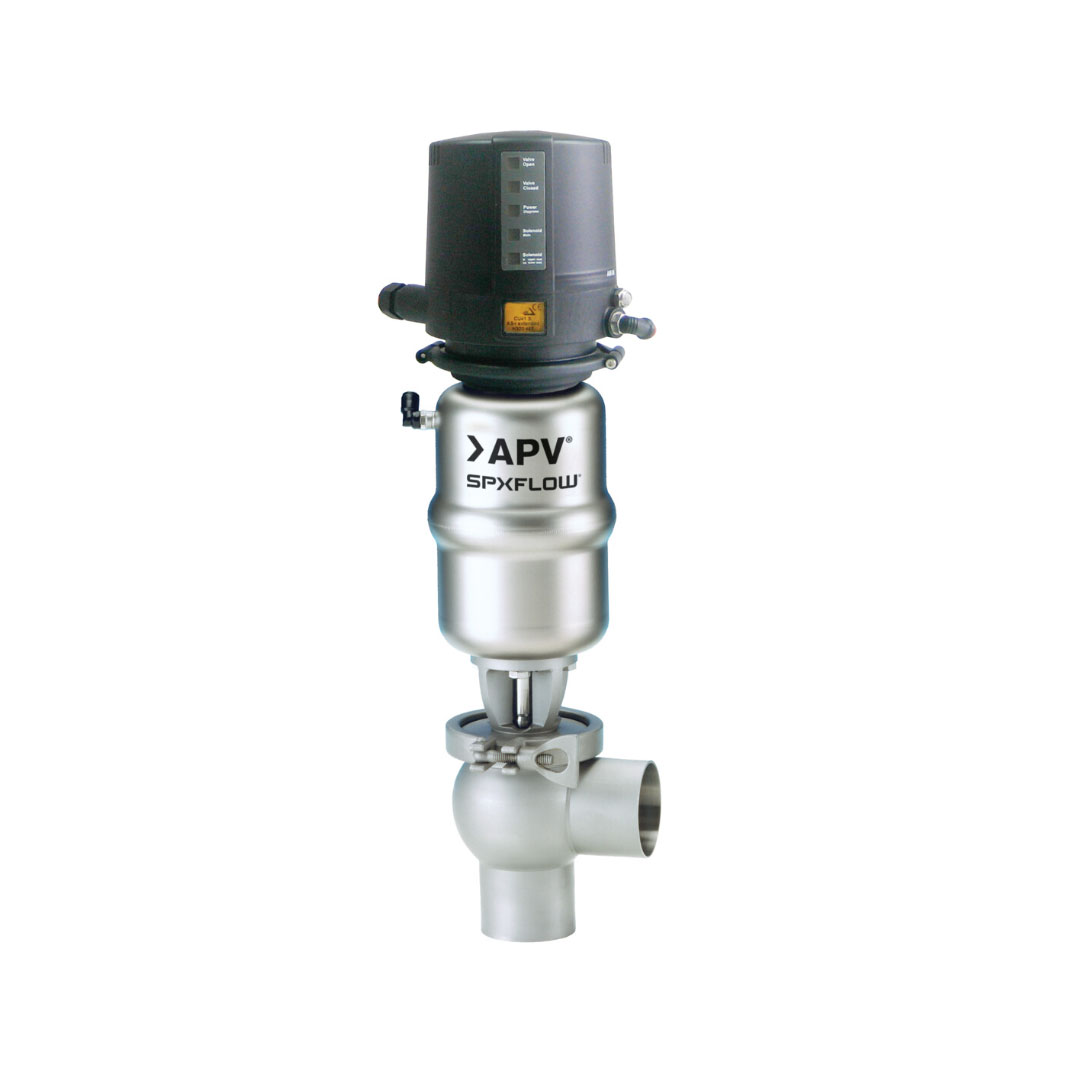
SW4 Series – Single Seat Valves
| Application | , |
|---|---|
| Access-products | |
| Brand | |
| Industry | , , |
The SW4 series hygienic single seat flow control valve is highly versatile and fulfills the demands of today’s processing industries. The hygienic valve design makes it ideal for applications in dairy, processed foods, beverage, brewery, and chemical industries.
SW4 Single Seat Valve Overview
Key Advantages
- Thick valve housing reduces stress in the seat area
- Wear-resistant elastomer/PTFE shaft seal and bearings extend seal life
- Convenient installation and maintenance
- Profile seals with markings for fast identification
- Metallic stop ensures proper compression of seat seal
- Ball-shaped housing reduces CIP cleaning time by preventing sump/dome formation
- Quick-release clamp closure for simple valve servicing
- Multiple housing configurations available
- Certified 3-A sanitary design
Construction Materials
All product-wetted components are made of AISI 316L / 1.4404 (DIN EN 100888) stainless steel. Seal materials include EPDM (standard), with options for HNBR and FPM.
SW4 Valve Variants
Configuration Options
- Manual actuation (SW4 H)
- Divert valve (SWS4)
- Tank outlet version (SWT4)
- High-pressure design (SWhp4)
- Steam barrier version (SW4 DPF)
- Long stroke variant for viscous media or large particulates
- Modulating cone option (SWR4)
- Tangential inlet/outlet configuration
- ATEX compliant versions
- 3-A version for enhanced hygienic applications
Nominal Dimensions
Available in DN 25 – DN 150 / 1” – 4”, and 6” sizes
Actuator Warranty & Reliability
The actuator supplied with this valve is covered by a 5-year actuator warranty, or up to 1 million actuations, whichever comes first. Built with fully welded, sealed, maintenance-free construction, it eliminates internal servicing and reduces wear components to deliver long-term durability in demanding hygienic processing environments.
Key benefits include:
- Maintenance-free operation with no internal servicing
- Fewer spare parts and improved total cost of ownership
- uptime and production continuity