

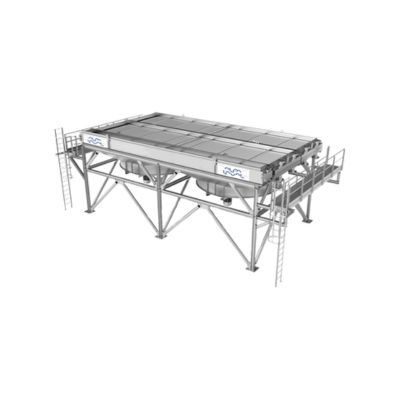
Finned tube air heat exchangers
| Application | |
|---|---|
| Industry | , |
| Brand | |
| Access-products |
With an Alfa Laval finned tube air heat exchanger you get a robust cooler that will deliver high performance for many years to come. Our product range covers most applications in oil & gas, data centers, hydrogen, RNG and CCUS. We supply both standardized and fully customized, engineered-to-order solutions. Thanks to their flexible designs, we can configure our heat exchangers to match your specific operating conditions, ensuring reliable operation, low operating costs and high performance.
Benefits of air-cooled finned tube heat exchangers
- Customized to your requirements
- Very low energy consumption
- Robust heat exchangers, built for tough duties
- High performance
- Low maintenance requirements
Unique air-cooled finned tube heat exchanger features
HyperFin
Slitted fin design maximizes heat transfer.
SealTight
Effectively prevents leaks from the plugs in the header box.
ALOnsite™
True onsite service by skilled engineers, anywhere in the world.
How the Finned tube air heat exchangers work
ACE Model E, Olmi API 661 and Olmi Model G
ACE Model A
The hot medium (e.g. hot water or lube oil) flows through the air-cooled finned tube heat exchanger within the large number of externally finned tubes. One or more fans force air across the tubes and the heat from the hot medium is transferred to the air. To maximize heat transfer, the tubes are equipped with fins that increase the area in contact with the air.
Alfa Laval offers a great variety of air-cooled finned tube heat exchanger designs in terms of:
- Number of fans
- Orientation of the fans (horizontal or vertical)
- Orientation of the tube sections (horizontal, vertical or sloped)
- Induced or forced draft
- Configurable plot sizes
Forced draft design
In air-cooled finned tube heat exchangers with a forced draft configuration the air passes the fan before it passes the finned tubes and the air is pushed through the tube bundles. The advantages with this include:
- The fan and belt is not exposed to the hot exhaust air, which increases component lifetimes.
- No temperature limit on the existing air.
- When the tube sections are horizontal, the fan is placed under the tubes, making access during service easier and costs for structure lower.
- Energy consumption is often lower as compared to induced draft units.
Induced draft design
In an air-cooled finned tube heat exchanger operating with induced draft the fan is placed after the tube sections, meaning air is pulled through the tube bundles. The advantages with this design are:
- A more even distribution of the air flow through the tube bundles.
- The risk of recirculating hot exhaust air is much lower thanks to a higher exit air velocity than in a forced-draft heat exchanger.
The combinations of forced/induced draft and the orientation of the fans and tube sections all have their individual advantages and ideal uses. Please contact your Alfa Laval representative for a discussion about the optimum solution for your specific conditions and application.
ACE – Working principle
Olmi – Working principle
Case story: Upgrade brought lower operating costs and reduced noise levels
Substantial savings in power consumption as well as reduced noise and vibration levels were the results when the fans, motors and transmissions of a 60-cell system of air-cooled finned tube heat exchangers in a European fertilizer plant were upgraded. Alfa Laval Olmi´s service organization handled the entire upgrade from initial planning to installation.